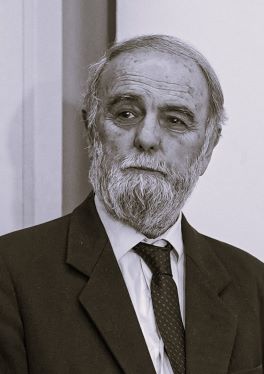
Academician Sava Halugin passed away
It is with deep regret that the Serbian Academy of Sciences and Arts (SASA) announces the passing of Academician Sava Halugin at the age of 81, on 23 April 2026, in Belgrade. Born on 17 April 1946 in Novi Kneževac, he was one of our foremost sculptors and painters.
He completed his studies in the Department of Fine Arts of the Higher Professional School for the Education of Teachers in Novi Sad in 1968. After that, he enrolled at the Faculty of Fine Arts in Belgrade, the Department of Sculpture, where he graduated in the class of Professor Jovan Kratohvil in 1972. After completing his post-graduate studies, he was awarded the title of Master of Fine Arts in Sculpture.
In the period between 1980 and 1994, he worked as a freelance artist in Belgrade. In 1994, he joined the Pedagogical Academy in Subotica, where he taught the course on the Methodology of Artistic Education with Practice. In the same year, his monograph Zemlja i metal (Earth and Metal) was published in Serbian and English. He undertook study visits to Greece, France, Italy, Austria, Germany, Hungary, Spain and Romania.
He participated in numerous collective exhibitions in Serbia and abroad. From 1979, he had solo exhibitions in Belgrade, Zagreb, Budapest, Paris and other art centres. His artworks can be found in the collections of the Museum of Contemporary Arts in Belgrade, the National Museum of Serbia, the Subotica Contemporary Gallery, the Serbian Academy of Sciences and Arts and various private collections. Many of his sculptures have been installed as artworks in public spaces in Subotica, Novi Sad, Kikinda and Sombor.
He was elected as a corresponding member of SASA in 2018 and became a full member in 2024. Within the Academy, he was a member of the SASA Board for Higher Education. In 2023, the SASA Gallery hosted a significant exhibition of his works titled ‘Sava Halugin: An Invitation to Delight. He was a member of the ULUS (Association of Fine Artists of Serbia) and ULUV (Association of Fine Artists of Vojvodina).
Since he developed his works in the spirit of understanding the nature of various sculpting materials and searching for a form, two major phases can be identified in Sava Halugin’s oeuvre. The first, related to the work in stone, marked the very beginning of Halugin’s work and lasted for almost twenty years. The second, characterised by bronze as a chosen material of distinct features, paved the way for the artist to explore intensively and bring about achievements within his art, beginning in the mid-1980s up to the present moment. Drawings and paintings occupied a special place in Halugin’s opus.
His artistic research encompassed a synthesis of the principal trends of Serbian modern sculpture, ranging from expressionism to surrealism, reflected in the dynamic articulation of sculptural elements. He also developed associative bronze forms, as well as sign-like structures suggestive of symbolic meaning. Through his sculptural language, Halugin revealed the quality of language as well as the fundamental states of creative existence.
Through his work, he left an indelible mark on the history of Serbian sculpture and fine arts. Over the course of his career, he received numerous awards and recognitions, including the Award for Creativity (ULUS, ULUK, ULUV), presented at the Cvijeta Zuzorić Art Pavilion, Belgrade (1978); the Moša Pijade Fund Award at the SULUJ exhibition, Belgrade (1982); the Jovan Popović Award, Novi Sad (1984); the October Award of the City of Subotica; the Golden Chisel Award (ULUS), Belgrade (1988; 1993); the Redemption Award at the Biennial of Contemporary Yugoslav Drawing Artistic Autumn, Sombor (1994); the October Salon Award for Sculpture, Belgrade (1995); the Iskra Kulture Award for Fine Arts, Institute for Culture of Vojvodina (2007); Second Prize in the invitational competition for the monument to Sava Vladislavović Raguzinski in St. Petersburg (2008); First Prize in the invitational competition for the creation of a monument to Mihajlo Pupin in Novi Sad (2010); First Prize in the invitational competition for the design of a Lifetime Achievement Plaque awarded by the Institute for Culture of Vojvodina (2010); and the Jakov Orfelin Award for Fine Arts, Sremski Karlovci (2018), among others.
His passing represents a great loss to the Serbian Academy of Sciences and Arts, as well as to Serbian and international art and culture.