Author Dr Milan Prosen Receives the Ranko Radović Award for His Monograph The Palace of the Serbian Academy of Sciences and Arts
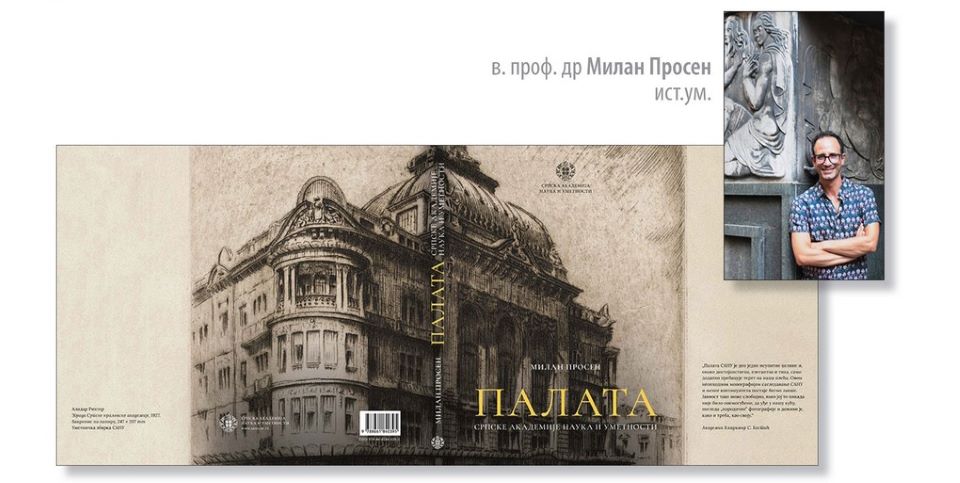
The recepient of this year’s Ranko Radović Award in the category of critical and theoretical texts on architecture, urban design, and the city is Professor Dr Milan Prosen, author of the monograph The Palace of the Serbian Academy of Sciences and Arts, published as part of the Special Editions series of the Presidency of the Serbian Academy of Sciences and Arts (SASA).
The Ranko Radović Award is presented by the Applied Artists and Designers Association of Serbia (ULUPUDS) as the founder, in cooperation with the Faculty of Architecture, University of Belgrade, the Faculty of Technical Sciences in Novi Sad – Department of Architecture and Urban Planning, the Institute for Architecture and Urban & Spatial Planning of Serbia, the Ilija M. Kolarac Endowment, the Urban Institute of Belgrade, the Engineering Chamber of Serbia, and Radio Television of Serbia as co-founders. The award ceremony was held at the Ilija M. Kolarac Endowment building.
The following can be highlighted from the detailed statement of the Jury’s President, Dijana Milašinović Marić, PhD:
’The monograph The Palace of the Serbian Academy of Sciences and Arts by Milan Prosen, PhD, represents an exceptional, comprehensive and multi-layered scientific work that takes up a special place in contemporary Serbian historiography and historiography of architecture. It is a work that transcends the framework of an architectural study and expands into the domains of cultural documentation, institutional memory and interpretive record of the establishment and development of one of the key symbols of national identity – the Palace of the Serbian Academy of Sciences and Arts.
Milan Prosen’s approach is a combination of archival precision, rigorous historical methodology and profound cultural sensitivity. The monograph is based on an extensive, often previously unpublished body of documents: competition and project records, drawings, minutes, private and institutional correspondence, photographs and texts from the time of its establishment. Thus, this monograph represents the first complete and scientifically reliable account of the development of the Palace of the Serbian Academy of Sciences and Arts in all its historical, stylistic, social and urban layers.
It is due to this interdisciplinary scope, scientific soundness, archival completeness and literary clarity that this monograph constitutes an outstanding contribution to contemporary Serbian science and architectural historiography, as well as a work that deserves the highest recognition. The author has succeeded in creating a work that is not only the result of scientific methodology, but also an act of cultural responsibility – an act of preservation and interpretation of one of the most important architectural and symbolic spaces of Serbia.’