
CONFLICT
4-18 JUNE
Author: Dušica Pejić
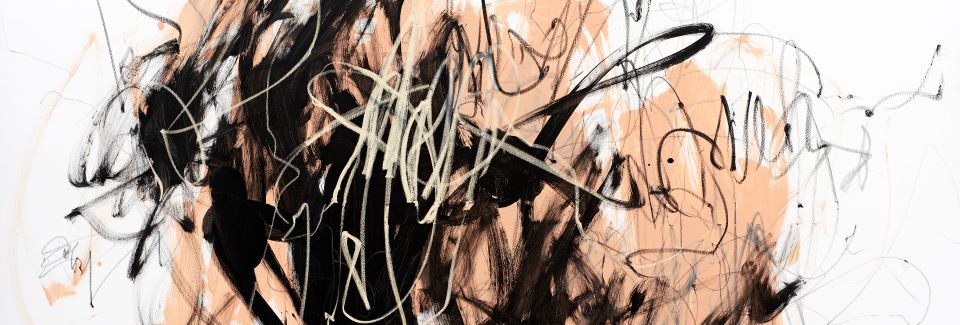
Following Carl Jung, who believed that ‘colours are the native language of the subconscious’ and that they ‘express the principal psychic functions of the individual,’ Pejić’s scaled-down palette may be understood as a struggle between the Self and the Shadow. The Shadow archetype operates as a narrative force that reveals the hidden, darker aspects of the personality concealed from consciousness. The Shadow functions as a symbolic repository of repressed desires, fears, and traits that the individual finds unacceptable. In this context, black may also be read as the alchemical nigredo — the stage of darkness and dissolution preceding transformation — as well as a psychological state of suffering that leads to an awareness of the illusory nature of the world.
As opposed to this forceful black gesture, there is a humanised light — quartz, nectar, skin, wax — representing the psyche in its resistance, softness, and efflorescence. Enantiodromia — Heraclitus’ notion of all things eventually turning into their opposites — suggests that what we perceive as opposites are often merely polar extremes within a single whole.
In Pejić’s work, however, this conflict remains unresolved on canvas. Her paintings do not possess the equilibrium and harmony of the alchemical swan, in which the black and white swans touch one another as if reflected in a mirror, evoking the tranquil image of the soul and the ‘harmony of silence.’ On the contrary, her forms are still warring against each other: tearing each other apart, yet continuing to search for one another.
It is precisely this paradox — that two opposing truths may coexist simultaneously — that points to Pejić’s need to remain within the tension itself, to endure the pull of extremes and, through that process, discover the line between polarities: the path along which her expression is continually renewed. As Jung argued, paradox is often a more faithful witness to truth than one-sidedness.
Aleksandra Lazar