PRISTINA PROVINCIAL CULTURAL CENTRE – LEPOSAVIĆ
5 November – 19 November
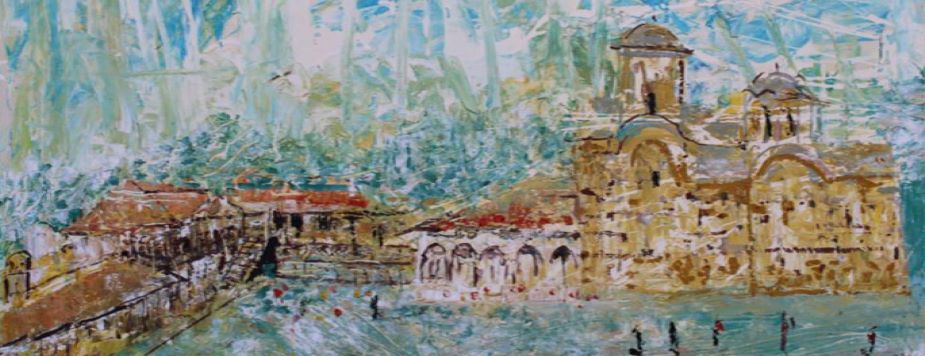
There are many reasons for remembering, but for organising this kind of exhibition, they are rooted in the thoughts and inner lives of the many people who once attended the Peć Art School. For them, it is not a closed chapter in the past but a living place of collective experience. Tied to a unique region and time, the Peć Art School became physically inaccessible to many in 1999, after fifty years of work in a Metohija town. However, it did not become completely distant, as memories of all that was best associated with the school have kept it close, preserving it in the stories and images of its professors and pupils. The first drawings, artistic guidance, dilemmas and friendships shaped students of this school and marked their innermost artistic aspirations and life paths.
For those who attended this school, initially the Applied Arts High School, later the School for Artistic Technicians, it was always known simply as the Peć School. The proximity of the Monastery of the Patriarchate of Peć, as well as the distinctive landscape of the surroundings – the Rugova Gorge, the Bistrica River and the town’s neighbourhoods – influenced the way they see and shaped the aesthetic models of numerous generations. As Mirko Radulović, a renowned set designer and painter, one of the school’s former students, observes: ‘A person carries the colours of their homeland within them; in my opinion, they can never free themselves from them, even if they wanted to.’
The school’s sensitivity to local themes and people was fostered by the artistic vision of its founder, Vlada Radović. In his work, contemporary artistic trends he became familiar with during his studies in Belgrade and his travels to European cities are intertwined with the spirit of Metohija embodied in the motifs of cobblestone streets, Serbian monasteries, Albanian towers, and local Muslim women in traditional dress and Roma women. His intimist sensibility, expressed most often through watercolour as his favourite medium, resulted in works that serve as a kind of document of their environment and time. Art historian Hivzi Muharemi emphasises his authenticity and ‘the way his surroundings become interwoven with the reality of his work ‘, while artist Nebih Murići highlights his emotional nature and shared life with his fellow citizens.
Although he was offered an additional scholarship for further studies in Paris, Vlada Radović returned to Peć following his graduation from the state Art School in Belgrade. Having established the first art school and having introduced new generations to the world of art, he went on to establish the Secondary School of Applied Arts in Peć in 1949, the first of its kind in Kosovo and Metohija. He taught specialist art subjects and recognised the talents of many students. Due to his role as the school’s founder and the support he gave to many students in their artistic development, he is recognised as the father and doyen of Kosovo painting tradition.
Radović was joined in founding the school by its first director, the sculptor Milan Besarabić, while the teaching staff included painters Svetozar Sveta Kamenović, Rufim Lazović, Boža Prodanović, Risto Otović and Luka Stanković. In the following decades, lecturers of the school were professors Radoslav Musa Miketić, Dragan Vukosavljević, Veljko Radović, Slobodan Mihailović, Šemsedin Kasapoli and other distinguished artists and educators.
The prominent artist and educator Pavle Popović, a former student of the school, recalls that the quality of teaching and the pedagogical authority of professors, based on work and discipline, provided a solid foundation for enrollment in art studies.
The exhibition organised by the Cultural Centre of the Province is one of the possible selections of works by authors – teaching staff and students – who had the Peć School as a personal experience. It is precisely in this artistic harmony that the vision in support of a collective memory is recognised. The exhibition also calls upon us to feel the artistic connections created in the school, as well as understand the unforgettable characteristics of the atmosphere and everything it embodies.
Professor Jelena Pavličić Šarić
Art Historian